

Key Takeaways:
- You should choose only FIU-registered exchanges for safer, compliant trading.
- Bybit, Binance, and KuCoin suit experienced and active traders.
- CoinDCX offers the easiest INR deposits and crypto purchases.
- Coinbase stands out for strong security and transparent financial reporting.
- Indian traders face 30% tax, plus 1% TDS, according to crypto laws.
Which Exchange Is Best for Crypto Trading in India: Our Top Picks
The best exchanges in India for crypto trading are Bybit, Binance, KuCoin, CoinDCX, and Coinbase. All five of these platforms serve verified Indian users and operate within India’s FIU reporting framework.
- Bybit: Best for futures trading
- Binance: Best for liquidity
- KuCoin: Best for altcoins
- CoinDCX: Best for INR-to-crypto purchases
- Coinbase: Best for security
5 Best Platforms for Crypto Trading In India Reviewed
The following section gives you a detailed look at the top 5 crypto exchanges in India. I tested every platform to check its features, fees, security, and overall performance before deciding which one could be the best crypto exchange in India for different users. You will also learn how these crypto platforms in India compare in trading costs, withdrawal times, and other important areas.
#1. Bybit: Overall best crypto exchange in India

Bybit is our #1 best crypto exchange in India currently. It operates fully in India right now after registering with the Financial Intelligence Unit-India (FIU-IND). It offers spot and derivatives trading, along with peer-to-peer (P2P) INR transactions. Indian residents also get local tax handling. Bybit deducts 1% TDS from crypto sales and crypto-to-crypto trades, and it also adds 18% GST to its service or trading fee.
| Supported Coins | 1,200+ cryptocurrencies available for spot and derivatives |
| Trading Fees | 0.02% maker / 0.055% taker (Futures), 0.1% (Spot) |
| INR Funding Methods | Peer-to-Peer P2P (UPI, IMPS, Paytm, PhonePe) |
| Trading Features | 100x futures leverage, grid trading bots, copy trading |
| FIU-IND License | Yes |
#2. Binance: The most popular place to buy Bitcoin in India

Binance is the best crypto exchange in India for liquidity. It became an FIU-IND reporting entity in August 2024, and its website and app returned for Indian users. The platform offers full access to spot trading, staking, earning products, and diverse digital asset portfolios.
| Supported Coins | 500+ cryptocurrencies available for spot and derivatives |
| Trading Fees | 0.1% maker/taker (Spot), additional discounts with BNB |
| INR Funding Methods | P2P network supporting UPI, IMPS, and Bank Transfers |
| Trading Features | Spot, futures, margin trading, auto-invest, ETH staking |
| FIU-IND License | Yes |
#3. KuCoin: The best mobile app to buy new altcoins

KuCoin is the best crypto exchange in India for altcoins. The exchange advertises access to more than 1,000 crypto assets, including many small tokens that do not reach Binance or Coinbase. It joined the FIU-IND framework in 2024 and now deducts 1% TDS on regular exchange trades for Indian users.
| Supported Coins | 1,000+ altcoins and emerging crypto project tokens |
| Trading Fees | 0.1% spot fee with automated 1% TDS deduction |
| INR Funding Methods | P2P system supporting UPI, Paytm, and IMPS |
| Trading Features | Spot, margin, grid trading bots, copy trading platform |
| FIU-IND License | Yes |
#4. CoinDCX: India’s first crypto unicorn

CoinDCX is the best crypto exchange in India for direct INR-to-crypto purchases. It serves more than 2 crore registered users and lists over 500 crypto assets. You can add rupees through a supported bank transfer, then buy Bitcoin or another coin without dealing with a P2P merchant.
| Supported Coins | 500+ digital assets with direct INR trading pairs |
| Trading Fees | 0.50% per trade (+ 1% TDS) |
| INR Funding Methods | Direct Bank Transfer (IMPS, NEFT, RTGS) |
| Trading Features | Spot, futures, direct INR fiat gateway, automatic TDS filing, BitGo insurance |
| FIU-IND License | Yes |
#5. Coinbase: The most secure platform for crypto trading in India

Coinbase is the best FIU-registered exchange in India for security controls and company transparency. It registered with FIU-IND in March 2025 and launched direct INR deposits and withdrawals through IMPS in May 2026. Indian customers now get spot markets, Simple Trade, Advanced Trade, crypto transfers, and eligible perpetual futures.
| Supported Coins | 250+ highly vetted, top-tier cryptocurrency assets |
| Trading Fees | Tiered structure starting around 0.40% to 0.60% standard |
| INR Funding Methods | International cards and select payment gateways |
| Platform Features | 98% offline vault cold storage, advanced security, simple buy/sell |
| FIU-IND License | Yes |
Comparing Top Cryptocurrency Exchanges Right Now
Every trader has different priorities when picking a crypto exchange. You might want the lowest fees for day trading, or maybe you just care about having the maximum number of coins available.
So, look at the table below to see how these best crypto trading platforms in India compare across key features like trading fees, coin count, payment methods, and automated TDS tax deduction support.
| Exchange Name | FIU-IND Status | Number of Coins | Maker / Taker Fees | Primary INR Payment Method | Automatic 1% TDS |
|---|---|---|---|---|---|
| Bybit | Registered | 500+ | 0.02% / 0.055% (Futures) | P2P (UPI, IMPS, Paytm) | Manual / User Responsibility |
| Binance | Registered | 500+ | 0.10% / 0.10% (Spot) | P2P (UPI, Bank Transfer) | Manual / User Responsibility |
| KuCoin | Registered | 1,000+ | 0.10% / 0.10% (Spot) | P2P (UPI, IMPS) | Automated |
| CoinDCX | Registered | 500+ | Up to 0.50% (Spot) | Direct Bank Transfer, IMPS | Automated |
| Coinbase | Registered | 250+ | Tiered (0.40% – 0.60%) | P2P / Bank Card Options | Automated / Regional |
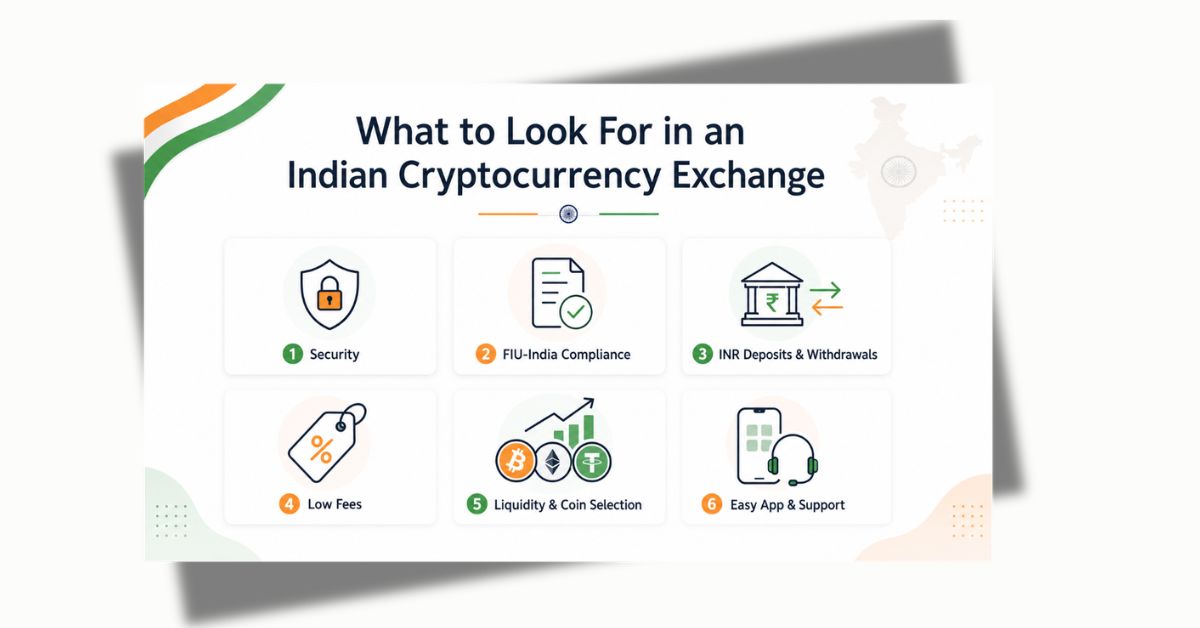
What to Look For In an Indian Crypto Exchange
Generally, choosing a reliable crypto exchange for Indians requires checking regulatory registration, fees, security standards, and payment methods. You should never send your funds to an unregistered exchange or a platform that operates in the shadows. Here are the criteria you can follow:
Official FIU-IND Registration
You see, regulatory registration is the single most important factor for Indian crypto investors today. The Financial Intelligence Unit monitors financial transactions to prevent money laundering and fraud. So, using an exchange registered with FIU-IND protects you from sudden government domain blocks or bank bans.
Nowadays, unregistered offshore crypto exchanges in India face URL blocks from Indian internet service providers and removal from Google Play Store and Apple App Store. You really need to avoid unnecessary legal risk by sticking strictly to platforms that have completed official registration.
Smooth INR Deposit and Withdrawal Systems
You want an exchange that supports direct Instant Payment Service (IMPS), UPI transfers, or zero-fee Peer-to-Peer (P2P) trading. Generally, fast rupee deposit options make your trading experience stress-free.
CoinDCX allows direct bank transfers straight into your exchange account. Binance and Bybit rely on P2P trading where you send rupees directly to another user’s UPI ID, and the exchange holds the crypto in escrow until payment clears. Remember, P2P may be risky and increase the chances of a bank freeze, so avoid it if you are worried about this situation.
Tax Compliance and 1% TDS Handling
Indian tax laws require a 1% Tax Deducted at Source (TDS) on every crypto sell transaction or crypto-to-crypto trade. Some exchanges handle this deduction automatically for you, while others leave the record-keeping in your hands.
Top Indian crypto exchange platforms like CoinDCX and KuCoin calculate and deduct 1% TDS automatically whenever you execute a trade. And that money goes straight to the Indian Income Tax Department under your PAN card number. You can then claim this TDS credit when filing your annual Income Tax Return (ITR).
Robust Security and Proof of Reserves
Security measures protect your crypto from exchange hacks and internal mismanagement. You need to look for multi-factor authentication, biometric logins, and hardware security keys.
Generally, top-tier exchanges publish Proof of Reserves (PoR) reports regularly. Proof of Reserves proves that the platform holds customer assets at a 1:1 ratio in physical cold storage wallets. To be exact, Binance maintains a $1 billion SAFU fund, while CoinDCX utilizes insured cold storage from BitGo to keep assets safe.
Liquidity and Low Trading Fees
You know, high liquidity ensures that your trading orders execute instantly at the exact price you want. Basically, slippage happens when low liquidity forces you to buy higher or sell lower than market rates.
Plus, trading fees also add up quickly if you execute multiple orders every week. Hence, high-volume Indian traders usually prefer global crypto platforms like Bybit or Binance due to lower maker and taker fee tiers.
Bitcoin Regulations and Taxation in India Explained
Indian cryptocurrency laws impose flat income tax rates and mandatory transaction deductions on all traders. The government treats all cryptocurrencies, non-fungible tokens, and digital tokens as Virtual Digital Assets (VDAs) under Section 115BBH of the Income Tax Act.
The 30% Flat Income Tax Rate: Income generated from transferring virtual digital assets faces a flat 30% tax rate in India. You must pay this 30% tax on any net profits you make from selling crypto for Indian Rupees or swapping one coin for another.
Also, the standard slab rates of income tax do not apply to your crypto gains, and an additional 4% Health and Education Cess applies on top of the calculated tax, along with applicable surcharges. You must pay this 30% rate regardless of whether you held the cryptocurrency for two days or two years. Here, short-term and long-term capital gain distinctions do not exist for digital assets in India.
Note: Tax laws in India do not allow you to set off losses from one crypto asset against profits from another asset. You cannot deduct your trading losses from your overall taxable income either.
How To Register on a Cryptocurrency App in India
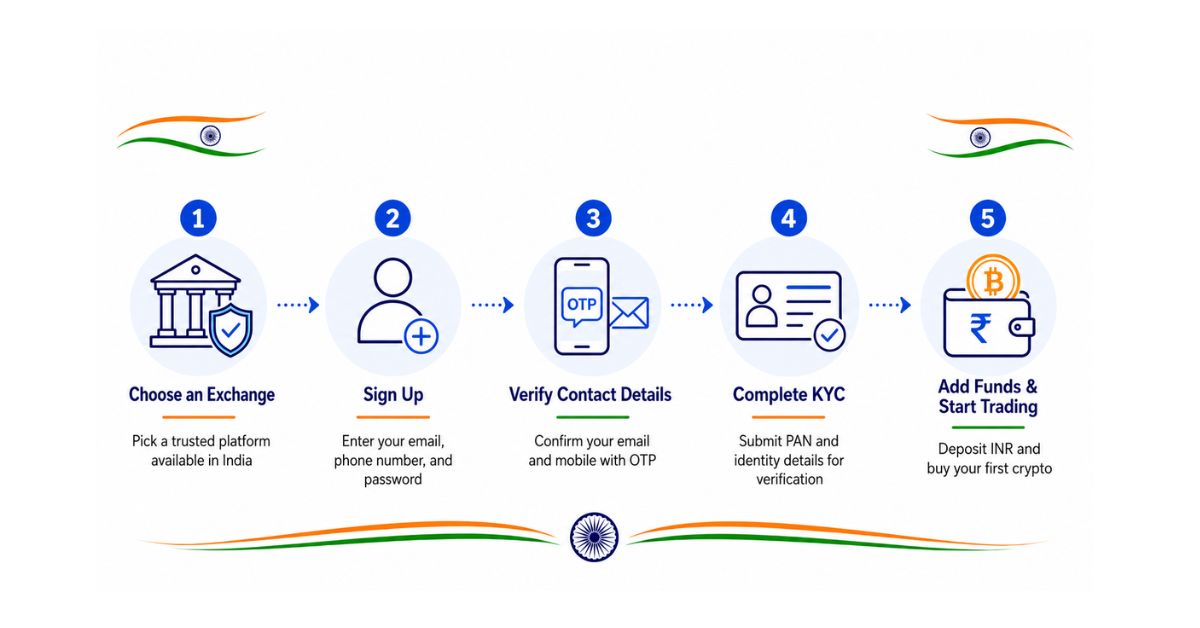
Registering on an FIU-registered crypto exchange in India requires completing mandatory KYC verification using your government identity cards. You can set up your active trading account in less than ten minutes if you have your identity documents ready.
Step 1: Account Sign Up
You must create your exchange account using an email address and mobile phone number. You know, most exchange apps send a six-digit one-time password (OTP) to your phone number and email address immediately to verify. Now, you should create a strong password containing capital letters, numbers, and special symbols to lock your login screen.
Step 2: KYC Identity Verification
Identity verification requires uploading clear photos of your PAN card and Aadhaar card to confirm your tax status. The automated system scans your PAN number to link your 1% TDS tax records directly to the Income Tax Department. You will also need to take a quick selfie photo to confirm that your real face matches your government ID photo.
Step 3: Indian Bank Account Linking
Actually, linking your personal Indian bank account easily allows you to make direct INR deposits using IMPS, NEFT, or UPI payment channels. The exchange app requires your bank account number and IFSC code to verify that the account name matches your official KYC documents.
Note: If you choose an offshore crypto exchange in India, like Bybit or Binance, you need to use P2P to deposit INR in your account.
Final Thoughts
In a nutshell, the best exchanges in India for crypto trading are Bybit, Binance, KuCoin, CoinDCX, and Coinbase.
Well, all five platforms reviewed in this post hold official Financial Intelligence Unit registration in India. You get proper regulatory protection, safe fund storage, and verified identity checks on every single platform. Basically, you can trade with confidence as long as you follow tax rules and practice good account security.
FAQs
Which is better for Indians, Binance or CoinDCX?
Binance is better for liquidity and lower spot fees, while CoinDCX is better for direct INR banking and simple tax records. You cannot directly deposit and withdraw Indian rupees using Binance through bank linking, whereas CoinDCX offers this with proper ease of use.
Which is the best crypto exchange in India right now?
CoinDCX is the best pure Indian crypto exchange right now for easy INR deposits, withdrawals, TDS records, and local support. Bybit is the better overall trading platform for Indian users who mainly trade futures.
Is cryptocurrency trading legal in India?
Cryptocurrency trading is legal in India, and you can buy, sell, hold, and transfer Bitcoin or other VDAs. But again, crypto is not legal tender, so no business must accept Bitcoin like the Indian rupee. FIU rules, KYC duties, the 30% VDA tax, 1% TDS, and tax-return reporting all apply.
What is the safest FIU-IND registered exchange?
Coinbase India is the safest FIU-registered choice in this list for security controls, audited public financial reports, cold storage, and corporate transparency.
What are the top crypto trading platforms for advanced traders?
Bybit, Binance, and KuCoin are the top licensed crypto platforms in India for advanced traders, offering futures, bots, margin trading, and advanced orders. Bybit leads for derivatives, Binance offers deeper liquidity, and KuCoin supports 1,000-plus altcoins.