
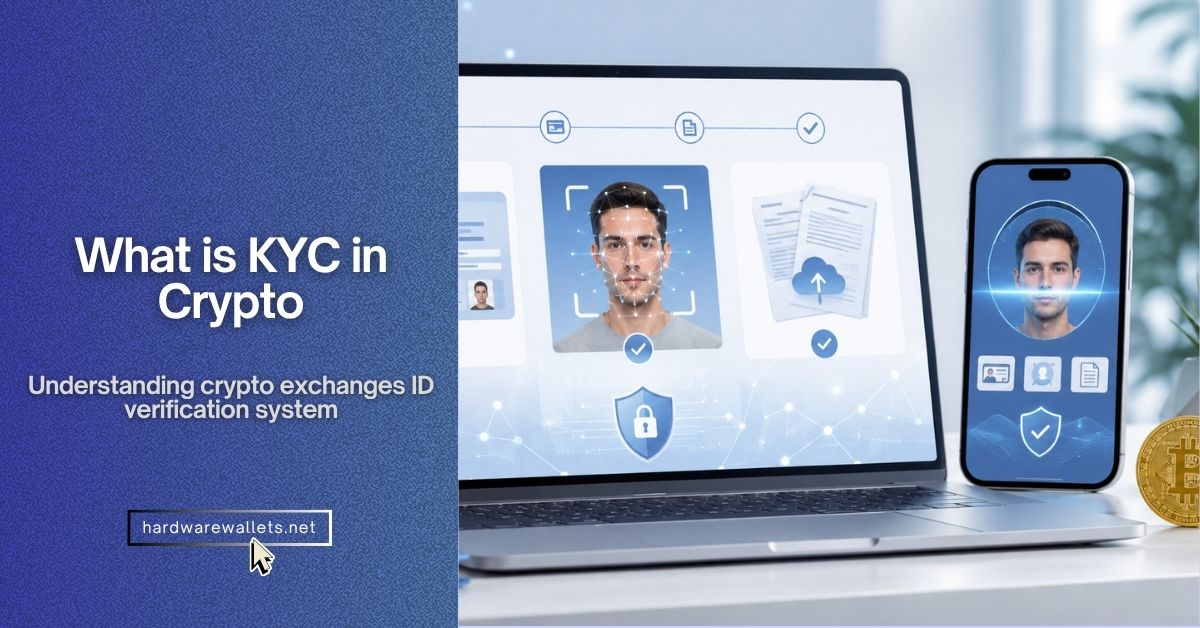
- KYC in crypto means a crypto exchange verifies your real-world identity before giving you full access to its services.
- The documents required to complete KYC on a crypto exchange are a passport, driver’s license, national identity card, selfie or facial scan, bank statement, utility bill, and sometimes proof of income or source of funds.
- Cryptocurrency exchange KYC is mandatory because it helps prevent money laundering, fraud, identity theft, illegal fund transfers, and sanctions violations while meeting regulatory requirements.
- The risks of completing KYC include reduced financial privacy, exposure of sensitive personal data, identity theft, data breaches, verification delays, and limited access for people without accepted documents.
What Does KYC Mean in Crypto?
KYC in crypto is an identity verification process where a crypto exchange checks who you really are before giving you full access to its services. KYC stands for Know Your Customer, and you generally complete it by providing your personal details, a government-issued ID, and sometimes a selfie or proof of address.
Now, here’s the part people don’t always think through: once you complete KYC on an exchange, your account stops being anonymous to that exchange. Your name, your ID, and your verified details are now tied to that account, and by extension, to whatever crypto flows in or out of it. That’s a pretty big shift from crypto’s “pseudonymous” reputation.
And just so you know, KYC isn’t some crypto-only invention. Banks have been doing this for decades. So have brokerages, payment apps, and pretty much anything that touches regulated money. Crypto exchanges just adopted the same playbook once regulators started paying closer attention to the industry.
KYC vs. AML: What Is the Difference?
KYC is a foundational part of a crypto platform’s broader AML program.
Hence, KYC is about one thing: confirming who you are. It’s the ID checks, the address verification, the selfie, all the steps that connect a real person to an account.
AML stands for Anti-Money Laundering, and it’s the bigger picture. AML is the entire system a company builds to detect, prevent, and report financial crime, things like money laundering, terrorist financing, fraud, and sanctions evasion. It includes ongoing transaction monitoring, suspicious activity reporting, sanctions screening, and continuous risk assessment, not just the sign-up step.
Check out my list of the best anonymous crypto wallets without KYC…
Why Do Crypto Exchanges Require KYC?
Crypto exchanges mainly require KYC to verify their customers and to meet the financial compliance rules of the countries they operate in. It’s not really optional for them. You see, if they want to offer fiat deposits, bank transfers, or card payments, regulators expect mandatory identity checks in return.
1. Prevent Money Laundering and Illegal Fund Transfers
The first reason is obviously money laundering. You know, cryptocurrency can be sent across the world in just a few seconds. So, without identity verification, criminals could easily deposit stolen funds, trade them into different coins, and cash out cleanly.
That does not mean KYC stops every illegal transaction. It doesn’t. But yes, the exchange can at least know who controls an account and then use transaction monitoring and other risk checks around that information
2. Prevent Fraud and Identity Theft
KYC protects both the exchange and everyday users from common scams, such as:
- Stolen credit or debit cards being used to buy crypto
- Fake accounts opened with someone else’s stolen identity
- Account takeovers and general account abuse
- Fraudulent deposits meant to game a platform’s systems
Well, if literally anyone could open an account with a throwaway email and zero ID, crypto exchanges would be flooded with fraud. And honestly, that cost usually gets passed down to regular users one way or another.
3. Meet Sanctions and Regulatory Requirements
Crypto exchanges also have to screen customers against sanctions lists and other risk databases, things like government watchlists tied to money laundering, terrorism financing, or politically sensitive individuals. That’s why every major US-based crypto exchange has mandatory KYC checks.
And this isn’t optional for them either. Regulators in most major markets require it, and getting it wrong can mean massive fines or losing the license to operate altogether.
How Does Crypto ID Verification Work?
Step 1: Enter Your Personal Information – You’ll start by filling in your basic details. Usually this means your full legal name, date of birth, country, and residential address.
Step 2: Upload a Government-Issued ID – Next, you’ll need to upload a photo or scan of an official ID. Most platforms accept a passport, driver’s license, or a national identity card. You’ll usually photograph both sides if it’s a card-style ID, and the system checks whether the document looks genuine and hasn’t expired.
Step 3: Complete a Selfie or Facial Verification – The exchange will ask for a live selfie, sometimes a short video where you turn your head or blink, so the system can confirm you’re an actual living person and that your face matches the photo on your ID. Well, this is usually called a liveness check, and it exists to stop someone from just uploading a photo of someone else’s ID.
Step 4: Verify Your Address if Required – Again, some safest crypto exchanges, especially for higher account tiers, will also ask for proof of address. Usually one of: A recent bank statement, utility bill, or an official government document. It just needs to clearly show your name and current address, and it’s typically only accepted if it’s a few months old at most.
Step 5: Exchange Reviews Your Information – Now, once everything’s submitted, the exchange is going to run it through their verification system. A lot of this is automated these days, so software checks the document for signs of tampering, matches your face against your ID photo, and cross-checks your details against various databases. If everything lines up cleanly, you might get approved within minutes, and of course, if something looks off, it usually gets bumped to a human reviewer, which takes longer.
How Long Does Cryptocurrency KYC Take?
Crypto KYC can take anywhere from a quick 2-minute automated approval to a much longer manual review, so there is no fixed verification time for every account. Actually, manual reviews can drag on, sometimes for days. A few things that tend to slow it down:
- Blurry or low-quality document photos
- Names that don’t match across your ID and your application
- Expired IDs
- Documents the exchange doesn’t support or recognize
- An address on your proof-of-address paperwork that doesn’t match what you entered
What Information Does a Crypto Exchange Check During KYC?
A crypto exchange’s KYC checks more than just the photo printed on your ID. An exchange typically checks:
- Whether your identity document is authentic and hasn’t been altered
- Your age, to confirm you meet the minimum requirement (usually 18)
- Your residency or location, since some services aren’t available everywhere
- Sanctions lists, to make sure you’re not a flagged individual or entity
- Politically exposed person (PEP) status where applicable, since public officials and their close associates get extra scrutiny
- Any suspicious or high-risk patterns tied to your application
- Sometimes, your source of funds, especially for larger accounts
Is KYC Mandatory for Crypto Trading?
No, KYC is not required to use cryptocurrency itself. But regulated centralized exchanges and fiat on-ramps commonly require identity verification before you can use their services.
Cryptocurrency, the technology, doesn’t ask for your ID. You can generally set up a self-custody crypto wallet, something like a hardware wallet or a software wallet you control yourself, without giving any blockchain network your name, your address, or anything about who you are. The blockchain doesn’t care who you are. It only cares about valid signatures.
But the moment you want to deal with:
- A centralized exchange
- A broker
- A custodian
- A fiat on-ramp
…you’re dealing with a regulated business, and that business almost always needs to verify you.
KYC Crypto Exchange vs. No-KYC Crypto Exchange
| Feature | KYC Exchange | No-KYC / Limited-KYC Service |
|---|---|---|
| Identity verification | Usually required | May not be required initially |
| Personal ID | Usually required | Sometimes not required |
| Fiat payments | Widely available | Often limited |
| Withdrawal limits | Usually higher after verification | May be lower |
| Regulatory oversight | More common | Varies greatly |
| Privacy | Less private | Potentially more private |
You can check out our list of the best no-KYC crypto exchanges here…
What Are the Benefits of KYC in Crypto?
- Easy Fiat Deposits and Withdrawals: You can easily link a standard bank account to buy or sell crypto directly for local cash.
- Higher Account and Withdrawal Limits: Generally, verified accounts have much higher daily and monthly limits.
- Better Account Recovery: If you get locked out of your account or lose your 2FA phone, submitting your ID helps customer support confirm ownership and restore your funds safely.
- Regulatory and Security Controls: Using a verified, regulated exchange means lower risk of the platform suddenly getting banned or frozen by regulators.
Does KYC Make Crypto Transactions Traceable?
KYC can connect your real identity to your exchange account, and to the wallet addresses you use to deposit or withdraw from that exchange. So yes, in that sense, activity on and around that exchange can be traced back to you.
But KYC doesn’t automatically make every blockchain transaction publicly show your name. The blockchain itself only sees addresses, not identities. What KYC actually does is create a link at the exchange level, between your verified identity and specific addresses. Now, once that link exists, on-chain analysis firms like Chainalysis can, in a lot of cases, trace activity from that address across the blockchain and connect it back to a verified identity if it ever touches a KYC’d exchange again.
So the honest way to think about it: skipping KYC doesn’t make you anonymous, and doing KYC doesn’t mean every transaction you ever make is out in the open with your name stamped on it.
Final Thoughts
KYC isn’t going anywhere in crypto, not for regulated exchanges anyway. Yes, it’s annoying to deal with sometimes, and it does trade away a bit of privacy in exchange for more functionality and better account security. But once you actually understand what’s happening behind it, it’s really not that mysterious.
If you’re using a regulated fiat-to-crypto exchange, expect to verify your identity at some point. But again, if privacy is your main priority, you’ve got other paths: non-custodial wallets, certain DEXs, P2P trading. You just need to go in knowing the trade-offs that come with each one.
More articles to explore: